Nature takes the lead on new York campus
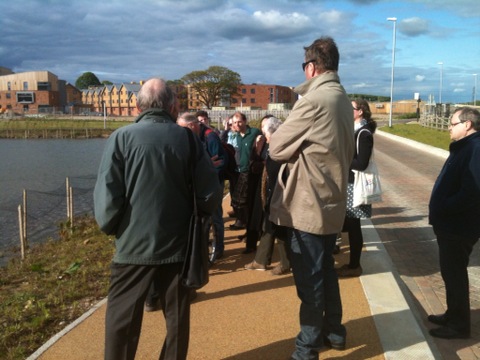
York Environment Forum enjoyed a change of scene for their May 2012 meeting, when the group went on a site visit to the new Heslington East campus of the University of York conducted by Director of Estates and Campus Services Jon Meacock and head groundsman Gordon Eastham, responsible for overseeing the planting on both sites.
They described the three-year planning process that had gone from turning the former greenfield site at Heslington East into the new University of York campus and the commitment to enhancing the bioversity of the area that was at the heart of this.
Central to this is the deep 10-hectare lake, lined with clay, which has a circulation system to ensure good water quality (unlike the lake on the main campus, which has poor water quality and does not support much life). The nutrient-rich topsoil from the lake excavation has been buried on Kimberlow Hill, which has been raised by 2-3m. This is now the site of one of the Woodland Trust’s 60 Diamond Jubilee Woods; 16,000 trees have been planted there so far and the hope is that it will become a significant ‘destination point’ in York.
A further 50,000 trees have been planted elsewhere on the Heslington East site, many of them to create ‘buffer zones’ around the campus to mitigate the effects of development on the local residents and to produce a parkland setting. Orchard trees have been planted nearer to the halls of residence so that students can benefit from the fruit. (There are also seven beehives cordoned off behind the pumping station on the far side of the lake, so in time the undergraduates may be able to enjoy local honey, too!)
The University landscaping team is working hard to discourage migrating birds from nesting in areas that are still being developed, employing fake ‘hawks’ to keep them away from building activity. However, elsewhere on the campus there is a great deal of breeding bird activity, and the presence of the bird life was remarked on by YEF members. It is rare that any of us hears skylarks nowadays, so listening to their liquid song tumbling from the overcast sky was one of the highlights of our tour. We were also accompanied by persistant and bold lapwings, whose ‘pee-wit’ shriek was obviously aimed at keeping us off their ‘patch’.
Other features to attract (and protect) bird life include owl boxes, two floating ‘tern rafts’ on the lake and a ‘hotel’ for sandmartins – a solid, wall-like structure on the south side of the lake with 50 holes plugged with sand, though this has yet to find tenants. Overall the bird surveys (conducted fortnightly during the breeding season) have revealed the site is already popular with avian visitors: 60 species, many quite uncommon, have now been logged. ‘It’s becoming quite an exciting site,’ says Gordon Eastham.
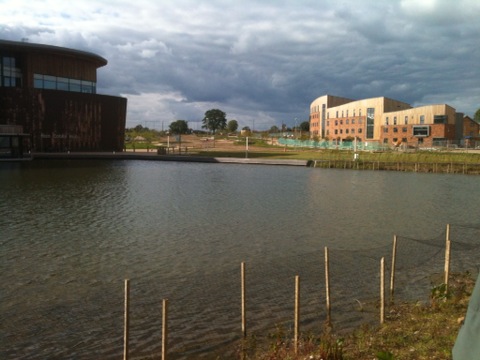 A baseline biodivesity survey of the site has been conducted and biologists at the university are studying how the biodiversity develops. The aim, says Eastham, is to let Nature take its course: the lake has not been stocked but sticklebacks are already appearing. Marginal plants have been put in around the lake shore (see left) but the voracious Canada geese that are such a feature (and a problem) on the main site means that many of the plants have been eaten. Ultimately, the team is aiming for 40 per cent semi-submersed vegetation (such as water lilies) on the lake, though the exposed nature of the site creates wave action so this is more likely to occur in sheltered areas.
The public can walk round much of the site (cars are not allowed) but there are no-go areas for dog-walkers, again in order to protect ground-nesting birds. It’s intended the area will become a prime spot for nature study: ponds have been created for this purpose and a strawbale hut is to be constructed that will be an educational centre for local schools.
One of the fascinating aspects of the Heslington East campus is the surface water drainage system. ‘Swales’ (see picture below) are an integral part of the system, and also produce another species set on their banks. the main source of surface water is the run-off from Badger Hill, which drains into a ‘detention area’, designed to withstand a 1000-year storm, as well
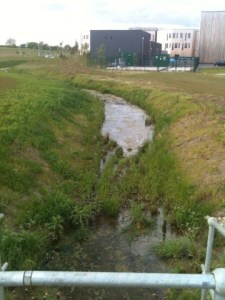 to contain any potential pollution incidents. Water is pumped from the pumping house to a reed bed of Norfolk reeds and blast-furnace shag, which filters out chemicals such as phosphates.
Clearly, the area is still very much in a state of transition. Woodland block planting (the team is using locally sourced trees suited to the environmental conditions and raising them in a tree nursery on site) is continuing, as is wildflower planting on the impoverished, scraped soils left by the removal of the topsoil (which wildflowers prefer).
Elsewhere, the ethos of letting Nature stake its claim is already starting to have an effect – bullrushes have established naturally and the migrating bird species have already excited bird-watchers. ‘We’ve turned Grade 1 agricultural land into an attractive bio-diversity-rich environment,’ says Jon Meacock.
Members of the York Environment Forum were impressed with the landscaping team’s work and the effort and thought that has gone into it. We are all interested to return to the site in a year’s time and see how the area has developed. We feel the landscaping plan could, and should, be promoted as a case study/guide to developers as an example and an inspiration of what can be achieved by working with Nature and we hope that the University of York will look to do this. We are also interested to see how the landscape will be managed in the future: it is deliberately designed to be low-maintenance, but it will still need some intervention. The hope is that student volunteers can be recruited to help supplement the cost of in-house work, and YEF feels that this could be another valuable area to study and promote.
Site tour of Heslington East campus
Members of York Environment Forum will be donning coats and boots for their May meeting, which sees them visiting the University of York’s Heslington East campus for a site tour.
The visit, arranged with Jon Meacock, will show the Forum visitors the progress of the landscaping work that has been done at the newly created extension to the University and demonstrate the ongoing work on biodiversity.
The meeting is on Wednesday 16 May and begins at the later time of 5.30pm to allow attendees to come after work. Meet at the Ron Cooke Hub and dress for the weather!
Afterwards, the Environment Forum will finish up its regular business and reports at a meeting room inside. The meeting is expected to finsih at 7.30pm. Refreshments are available to purchase at the Ron Cooke Hub.
New members, guests and observers welcome.
Green Economy and Bees on the Agenda for April
The Mini Stern Review for York will be the main item on the agenda for April’s Environment Forum meeting. It will be presented by one of the report’s authors, Corrado Topi, of the Stockholm Environment Institute at the University of York. Members of the York Economic Partnership have also been invited to attend the presentation.
The other main agenda item will be a discussion on how to ‘Get York Buzzing’ led by Vicky Kindemba of Buglife and linking with Friends of the Earth’s bee campaign.
The agenda is available to view under the Agendas tab.
The meeting is on Monday 16 April, Committee Room 2, Guildhall, York, 4.00-6.00pm. Observers and new members welcome.
‘Stern talking’ over York’s economic strategy
York Environment Forum discussed the economic case for prioritising environmental issues at the group’s recent meeting, highlighting the cost benefits of reducing carbon emissions to the city’s economy.
The discussion, in response to the consultation on the York Economic Strategy presented by City of York Council’s Economic Development Officer, Katie Stewart, addressed the financial advantages of investing in green technology and retrofitting programmes, actions vital for the city to reach its carbon reduction targets.
YEF Chair Kate Lock, who recently attended a seminar on behalf of the Forum with Professor Andy Gouldson, Director of the Centre for Low-Carbon Futures at Leeds, talked about the ‘Mini Stern Reviews’ for individual cities that Gouldson and his team have compiled – including a Mini Stern Review for York– and suggested that YEP should adopt its recommendations.
She extended an invitation to Katie Stewart and members of YEP to meet informally with one of the report’s authors, Corrado Topi, to discuss the findings and ways to incorporate them into the Economic Strategy.
The Mini Stern Reviews – inspired by the overarching review by Lord Stern in 2006, which put the economic case for acting on climate change – were first produced as an action plan for Manchester and subsequently for Leeds City Region. They have been well received by business communities, with more than 300 people attending the LCR launch. The Leeds Mini Stern’ shows 10 per cent of city-scale GDP leaves the city annually in payment of energy bills, and demonstrates how investment in energy efficiency and low carbon measures could reduce this to just over 1 per cent, as well as helping with financial viability, employment and increased wider economic and social benefits.
Leeds City Region now has a key ambition to be ‘a world-leading dynamic and sustainable low carbon economy that balances economic growth with quality of life for everyone’ and specifically identifies ‘facilitating a low carbon economy’ as a clear strategic priority.
The York Economic Strategy currently has no such ambition and does not identify commitment to a low-carbon economy as one of its objectives, despite the fact that a reduction in per capita carbon emissions is one of its key indicators of success.
The Mini Stern concept is now being taken up by other cities around the world – Gouldson and Topi have been asked to take them to Denmark, Calcutta, Tokyo and Beijing – demonstrating an appetite for embracing the economic opportunities offered by low-carbon technologies by the new economic superpowers.
‘York aspires to be one of the top ten European cities for its size in terms of its economy, but other cities in Europe and around the world are far more forward looking than we are in terms of attitude to climate change and the green economy,’ said Kate Lock. ‘We have got to get York on board now with all of this. It’s essential for us to reduce our carbon emissions, and the targets will be very difficult to achieve as it is. If we do not start to integrate an ambition to become a low-carbon city now, as part of our economic strategy, then we will not only have no hope of reaching our targets but we will miss out on real opportunities to grow the local economy and provide much-needed jobs.’
Other Forum members also expressed their concerns about York’s insularity, complacency and lack of vision, as well as cynicism about their ability to affect the economic strategy.
Pictures from YEF’s Climate Week 2012 stall
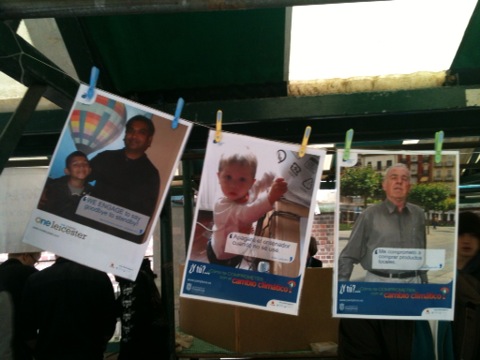
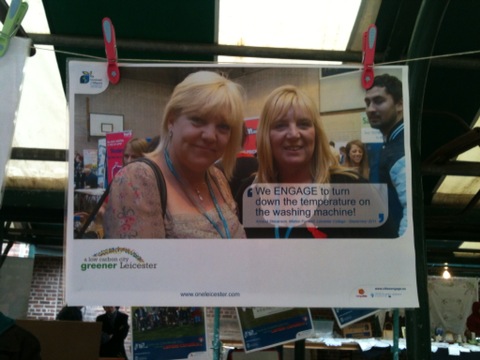
Engaging Views for Climate Week
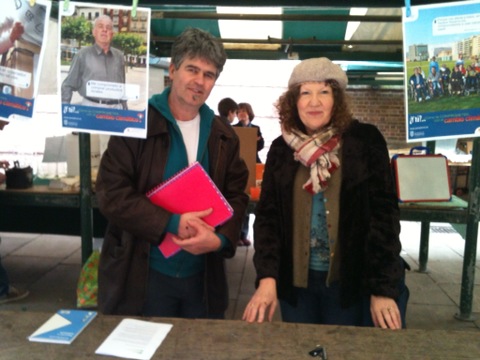
The Environment Forum will be taking part in the Be a Climate Saver event at York’s Newgate Market on Wednesday 14 March, as part of a programme of activities put on by voluntary groups, businesses, organisations and City of York Council to mark Climate Week 2012.
The Forum will be using the opportunity to pilot the ‘Engage’ Campaign in York, an international campaign to raise awareness of climate change and showcase the actions that are being taken by people from all walks of life to combat it. The campaign is an initiative of the Covenant of Mayors and the Forum hopes to launch it formally in York soon.
Christian Vassie, an independent filmmaker/composer and former executive member of City of York Council, is spearheading the campaign for the Forum and will be out and about with his camera to interview members of the public about their environmental hopes and dreams for the city.
‘York aspires to be a leading environmentally friendly city but there’s a lot of work still to do to achieve that,’ he said. ‘I want to talk to local people and find out from them what actions they would like to see us taking here in York that would help us to become a landmark sustainable city.’
York Environment Forum Chair Kate Lock, who is working with Christian on the project, said: ‘This is a great opportunity for us as a Forum to engage with members of the public. Normally we have quite formal meetings that involve a lot of talking, so it’s good to get outside and do some listening and doing for a change!
‘We are keen to work with the council to raise awareness of the issues surrounding climate change and how it will affect our lives – and what we can do to help mitigate that. We know lots of people are taking actions, whether it’s walking the kids to school instead of driving them, drying the washing outside instead of tumble-drying it, or buying local produce from local shops. By yourself, they can seem like insignificant things to do – but if we all did these things, the impact would be enormous.
‘That’s what we want to do with Engage! York: show what people are already doing – and inspire others to do the same. European cities are way ahead of us in this area and if we are serious about being an environmentally sustainable city we all need to do our bit.’
‘Ban pesticide and save bees’ – call to York MP
YEF Chair Kate Lock has written to York Central MP Hugh Bayley, calling on him to support an Early Day Motion to ban neonicotinoid pesticides that are killing honeybees. Letter to Hugh Bayley MP about neonicotinoid pesticides and bees
This follows a presentation by Guy Wallbanks of York and Ryedale Friends of the Earth, who spoke to February meeting of the Environment Forum about the dangerous decline in the honeybee population – and how people can do to help nurture bees and save them by planting wildflowers. He is asking York residents to sow wildflowers in their gardens and to cultivate wildflower plug plants for transplanting to other suitable sites locally. Councillor Dave Merrett, who attends the Forum on behlaf of the York Labour Group, said the City of York Council was supportive of increasing wildflower planting in the city.
Forum member Mick Phythian, of York Natural Environment Trust, mentioned Wildflowering York, a leaflet by Yorkshire Wildlife Trust to encourage wildflower planting on verges and other green spaces. Guest speaker Hugh Cripps of the Yorkshire Energy Partnership, who gave a presentation on the Government’s Green Deal, mentioned the Natural Beekeeping Trust, http://www.naturalbeekeepingtrust.org/, He also referred to the BBC2 series, Bees, Butterflies and Blooms, which is championing the planting of wildflowers to encourage insect pollinators.
University of York ‘lags behind’ in sustainability stakes
A report by the University of York’s Sustainability Forum states that, if the university were to be awarded a degree in sustainability, it would only manage a ‘lower second’.
The report was presented to members of the York Environment Forum at their February meeting by Professor Colin Campbell, who said that the University of York ‘lagged behind’ best performers and had slipped from 35th position in the People and Planet Green League in 2009 to 83rd by 2011.
Based on a comparison of published data available on university websites, Professor Campbell’s report criticises the University of York on a number of counts:
- little information about sustainability on its web pages
- no apparent sustainability strategy or administrative structure
- no commitment to sustainability through endorsement or declarations
- unambitious carbon targets and little evidence of planning for carbon reductions beyond 2020
- low targets for renewables – only 10 per cent of energy to be generated on site
- no targets at all for waste management, procurement and biodiversity
- no evidence of an attempt to introduce sustainability into the curriculum
- lagging behind the best in the sector in sustainable technology and having the most sustainable buildings
The report, published in December 2011, also identifies a deeper institutional problem, which it calls ‘the lack of importance that appears to be attached to this issue [sustainability] compared to other identified strategic objectives, such as excellence and internationalism’.
However, there is some praise for the university in the report, too. Its authors salute the planting of 45,000 mainly broad-leaf trees on the campus at Heslington East and single out the comprehensive analysis of the university’s carbon footprint by the Stockholm Environment Institute, which has one its UK bases at the University of York, as ‘ground-breaking’.
Read the full report here: University of Yorks Record on Sustainability- A Comparative Perspective
Forum’s voice adds to momentum against Monks Cross
YEF’s case against Monks Cross was reported in The Press on Wednesday 15 February 2012, the same day that the LDF Draft Core Strategy was formally submitted. These were covered as two separate stories and The Press did not make a connection between them.
http://www.yorkpress.co.uk/news/communitystadium/news/9531916.1_200_speak_out_on_Monks_Cross_scheme/
Forum’s Monks Cross objection makes Minster FM news
York Environment Forum deputy Philip Crowe, who has submitted a detailed objection to the Monks Cross retail development proposal on behalf of the Forum, has been interviewed by Minster FM. Soundbites from the interview are being run in news bulletins today.

 York Environment Forum