Exhibition showcases innovative housing designs


York Environment Forum has hosted an exciting new exhibition showcasing the best in innovative housing design.
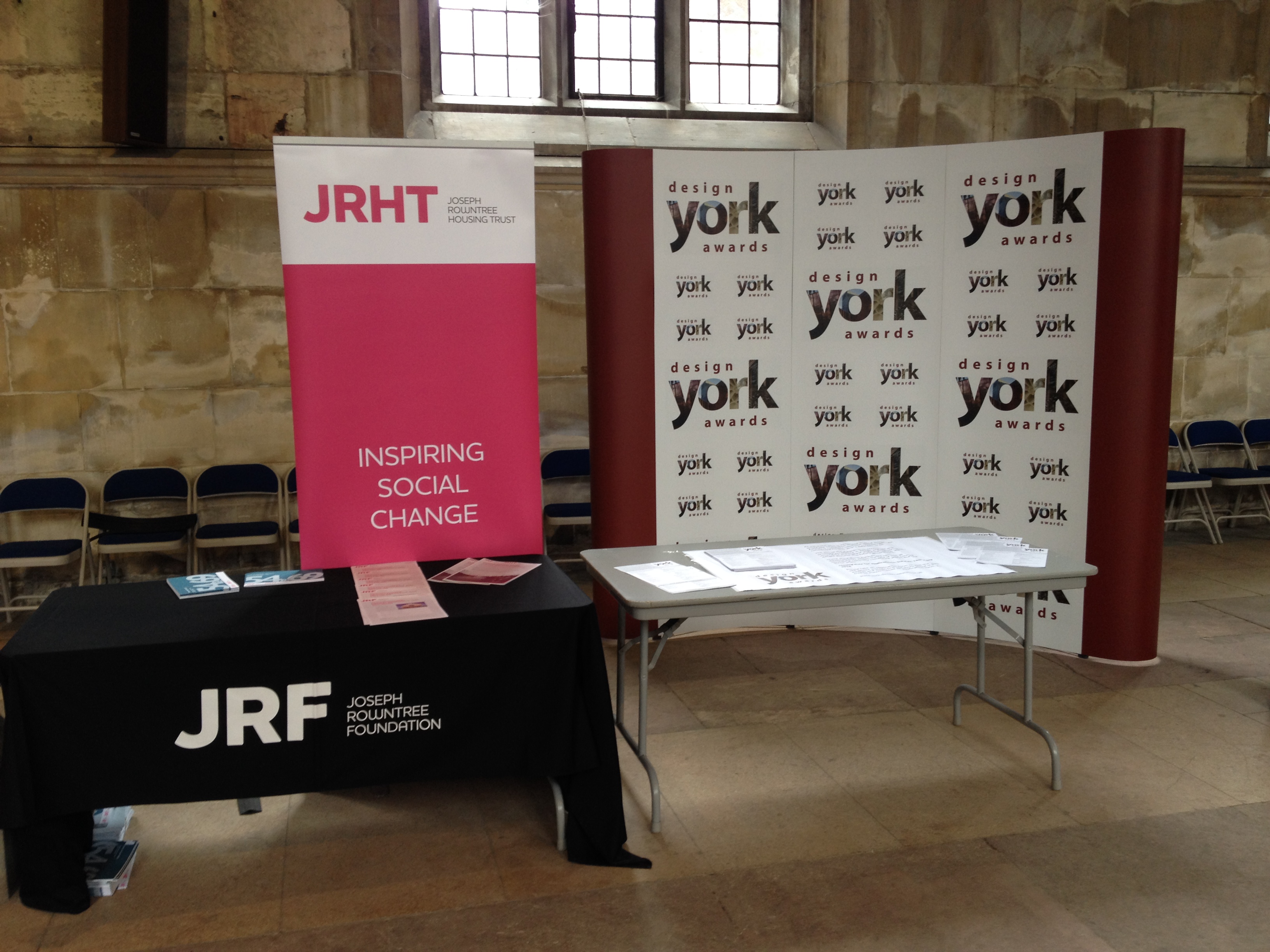
The exhibition, which brought to York the Housing Design Awards 2013, went on display at York’s Guildhall from 17 – 24 March 2014.
The winning schemes include the Joseph Rowntree Housing Trust’s Derwenthorpe development at Osbaldwick, York, as well as other housing schemes in Harlow, Clissold Park and Barking Riverside.
To accompany the exhibition the Forum held a talk on New Developments in Housing by architect Phil Bixby of Constructive Individuals (pictured above).
The exhibition was organised by Philip Crowe, Deputy Chair of York Environment Forum, with assistance from Phil Bixby.
York Environment Forum acknowledges grateful thanks to Joseph Rowntree Housing Trust, Yorkshire Housing and Home Group for their support for this exhibition.

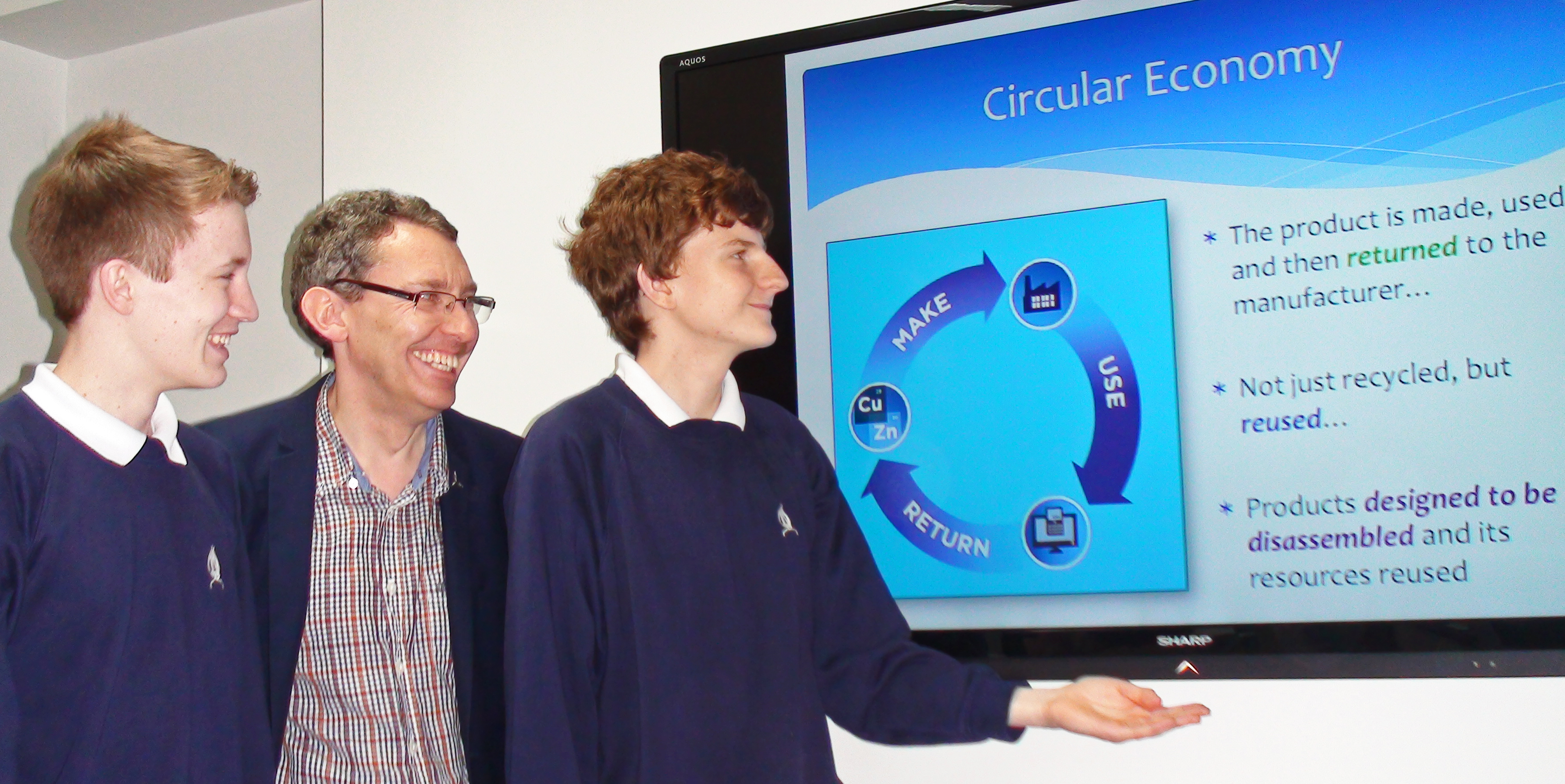
Students from Archbishop Holgate’s CE School in York and an academic from the University of Leeds presented the case for new economic models to York Environment Forum on Tuesday 11 March 2014.
Sam Rippon, 16, and Ethan Lewis, also 16, talked about the need for industry and businesses to reuse precious resources, encouraging a transition to a circular economy where products are loaned, hired or shared rather than being privately owned. The students showed a film they had made and explained the ethos of the circular economy, which makes use of innovative design and technical solutions to ensure that resources are continually reused rather than being thrown away.
Archbishop Holgate’s is a Pathfinder school for the circular economy, which is promoted by internationally renowned sailor Dame Ellen MacArthur through her own Foundation. The school is putting the ideas into practice in lessons and in the way it operates so that its pupils can take their learning into the workplace when they move on. It was visited by Dame Ellen in 2012 as a prize for the film they made explaining the concept.
Forum members also watched the film Enough is Enough: Building a Sustainable Economy in a World of Finite Resources, made by Leeds-based filmmaker Tom Bliss and featuring interviewees including Professor Kate Pickett of the University of York and Natalie Bennett, Leader of the Green Party.
The film was introduced by Dr Tim Foxon, Reader in Sustainability and Innovation at the University of Leeds and presents the case for a steady-state economy based on ‘enoughness’, equality and justice that recognises planetary boundaries. Dr Foxon is a colleague of Dan O’Neill and Rob Dietz who co-authored the highly praised book by the same title, which has generated much media interest since its publication last year.
‘We found the presentations really inspiring,’ said Kate Lock, Chair of York Environment Forum. ‘We’re now planning to get together with other partner organisations to arrange a much bigger public event so that we can air the ideas more widely and, hopefully, influence how we do things in York.
‘Companies such as Google, Ikea, Philips, Unilever, BT and Morrison supermarkets have all signed up to circular economy principles, as has Denmark and the Scottish Government. It would be fantastic if York could be the first local authority to sign up to the Circular Economy 100.
‘Not only would it demonstrate that the city takes sustainability seriously, but it makes good business sense. With all the design and technology industries in the city, York is the perfect place to demonstrate how the circular economy can work and it would put our young people ahead of the curve, too.’
British Sugar/Manor School Site Consultation Response
A public consultation on the redevelopment of the former British Sugar site off Boroughbridge Road in York has taken place this week, with a chance to view an exhibition and walk the site. You can read about it here. In February 2011, York Environment Forum responded to the SPD on the redevelopment of British Sugar/Manor School, which is available to read here – British Sugar-Manor School
The consultation will also be discussed at the next meeting of York Environment Forum on 10 December 2013.
Defra’s air quality review slammed
The following letter was sent to Defra in response to its recent consultation reviewing air quality monitoring.
York Environment Forum opposes Defra’s proposal to close Local Authority air pollution monitoring stations and to remove the need for LAs to declare Air Quality Management Areas. The reasons given in your consultation are specious. Monitoring provides raw data on the air quality: the fact that measures to improve air quality are ‘difficult to quantify’ is not a reason to cease monitoring, but rather to improve the measures and the means of analysis. To remove the monitoring stations altogether – and, critically, the requirement for Local Authorities to act on levels of air pollution that breach EU regulations – is akin to shutting your eyes and pretending it isn’t happening.
Similarly, the fact that ‘few authorities have been able to revoke any Air Quality Management Areas as a result of their interventions’ is no more reason to remove monitoring. The ‘We haven’t fixed it yet, so let’s stop bothering’ approach is positively dangerous: is the Government really prepared to play Russian roulette with public health? It’s also unjust and, arguably, immoral. Areas of social deprivation tend to have worse air quality and it is the poor, who already have a shorter life expectancy, that will suffer the most.
The argument that LAQM is ‘ very administrative’ is risible as an excuse for removing monitoring stations. The establishment of LAQM’s has prompted local authorities to compile Low Emission Strategies and create Low Emission Zones and to take positive measures to reduce air pollution. If it were not for the administrative framework – and the legal implications – we doubt that LAs would make these actions such a priority.
We do indeed face a significant challenge in meeting health-based EU limits for air quality and there are legal and financial penalties for infraction. This, we suspect, is the real reason for wanting to remove air pollution monitoring (and it is why these regulations were drawn up in the first place). Of course, it is vital that that local authorities focus their actions on what is needed to achieve these obligations and to reduce the public health impacts of poor air quality, but if monitoring does not take place at the same time, how can any scientific rationale be applied?
There needs to be scientific assessment and reporting alongside action to improve air quality, otherwise we will be working without criteria. We would like to think that Government will not be using the increase in premature deaths from heart failure, respiratory conditions and cancer caused by particulates as a more reliable guide to local air quality than the present monitoring arrangements.
If there is a need to ‘reinvigorate and refocus’ LAQM on helping the UK meet EU air quality standards (how will anyone know, without monitoring?) it is to take the issue of public health seriously. The costs supposedly ‘saved’ by closing monitoring stations will be miniscule compared to the costs incurred by the Health Service in treating people, especially the young, old and chronically sick, for the effects of our increasingly bad air pollution.
Here in York several AQMAs have been established and they are driving the City of York Council’s Low Emissions Strategy. We in York Environment Forum feel there should be more, not less, real-time, publicly available, local information available on air quality. This not only enables citizens to make informed decisions about their own journeys but it stimulates and drives action and measures to improve air quality.
You cannot fight your enemy if you don’t know where it is, what it is doing and how strong it is.
We oppose the removal of air quality monitoring and the need for LAs to declare AQMAs in the strongest possible terms.
Kate Lock
Chair, York Environment Forum
13 September 2013
York Environment Forum future – survey
Following a visioning workshop on 13.08.13 in which we discussed future potential roles and organisational structures for York Environment Forum, we have compiled a survey for our membership. The survey can be found here
If you are not a member of York Environment Forum but would like to join, please contact the Chair here
Membership is open to representatives of environmental groups, community and voluntary groups, businesses, organisations, parish councils and private individuals with a keen interest in environmental issues
York Environment Forum welcomes the opportunity to comment on the City of York Local Plan Preferred Options June 2013.
There is much that we support in the Plan, and we are especially pleased to see the recognition given to the importance of York’s green infrastructure (Section 17) with policies on GI, biodiversity, trees, open spaces and green corridors and also to climate change and renewable energy (Section 20), as well as policies to tackle the very real dangers posed by flood risk (Section 19) and air quality (Section 21). We support the stated ambition to create sustainable developments (Section 10), to improve building standards (Section 20) and to promote sustainable transport (Section 22) and to define the green belt (Section 18) with the provisos mentioned below.
We do, however, have major concerns regarding some of the strategic sites on land that is currently regarded as green belt, not only in terms of their locations but also in terms of their size. We find the projections for economic growth and the housing numbers (Section 10) to be unrealistic and over-ambitious and we are deeply concerned about the impact such policies will have on the future development of York.
York has a key ambition to be a ‘leading environmentally friendly city’ as part of its overall vision, as set out in The Strategy for York. We support – and, indeed, champion this – but we do not feel that the talk about sustainability in the Local Plan (which many of our members feel is no more than ‘rhetoric’) fits with the targets for growth as set out in the Plan.
Our detailed response, to which a number of our members contributed, can be found on the page headed ‘Reports‘.
The Draft Local Plan for York, published June 2013, differs from the previous Core Strategy (withdrawn following criticisms from the Government Inspector) in that it takes a new approach, based on population growth and, crucially, projections for economic growth in York, and derives a sum for housing numbers from that.
York Environment Forum feels that the equation is simplistic and the logic dubious: there is not a linear relationship between them and the variables are many – especially for growth.
Given that this is the foundation on which the York Local Plan is based, we challenge the formula at its heart and wish to see further public examination of this. We consider that, given the issues raised by Arup, York would be wrong to accept the preferred option (Option 2) for housing and should instead adopt the lower number (Option 1, 850 dwellings p.a.).
It is vital that York agrees a Local Plan. However, we feel that, as it stands, the preferred options on housing and growth make it vulnerable and may undermine its viability. We must get it right this time, for the sake of York’s future.
York Environment Forum does not wish this Plan to fail. If it does, York will be subject to the NPPF for its future development, which would result in a ‘free for all’ for developers with no local guidance to protect York’s special qualities.
York Environment Forum wishes to engage in a full debate to resolve the issues above and modify the approach. We are happy to co-operate and support the City of York Council in any way we can to assist with this.
Kate Lock, Chair, York Environment Forum
YEF members pitch City leader their ‘Green Christmas Wish List’
Members of York Environment Forum presented Cllr James Alexander, Leader of the City of York Council, with their ‘Green Christmas Wish List’ at a meeting on 3 December meeting 2012 at The Guildhall in York.
Attendees at the meeting were invited to pitch one ‘big idea’ and one ‘quick win’ – or to ask a question – in a timed two-minute presentation per person.
Pitches ranged from the ambitious (a Rapid Transit Line across York, solar footbridge, new public park) to the pragmatic (grow veg instead of flowers, bike racks at bus stops, a grand ‘freecycle’ day), and from the controversial (admit a lack of interest in the natural environment, return Rowntree Park to flood meadow) to the strategic (take over the bus service, encourage low-carbon jobs).
Councillor Alexander listened to all the pitches and responded briefly to each – with some provocative and revealing answers himself. The news that there are ‘no guarantees’ that York’s ‘green wedges’ will be protected was a particular concern to Forum members, as was the implication that the city ecologist’s team face a very uncertain future. Cllr Alexander made a particular call for interest to set up an energy co-operative in York. York Environment Forum plans to follow up with him over that and the other ideas he responded positively to.
A summary of the ideas and James Alexander’s responses is given below.
1. RAPID TRANSIT LINE: build a good-quality rapid transit line across York and locate all major traffic generators along it over the next 10-15 years. Start now with feasibility study. [Alastair Cooper, York Quakers (Friargate)]
James Alexander: I am keen on tram links, York is ripe for a tram. There has been European Investment Bank/ERDF underspend in our region; a tram line could be built for 200 million euros at a very low interest rate.
2. GIVE POLICIES WIDER FOCUS, NOT JUST CITY CENTRE [Alastair Cooper]
JA: I would like to look at York extending the Park & Ride service beyond the Local Authority boundaries, which would reduce car usage and congestion.
3. HOW CAN YOU ENCOURAGE PEOPLE IN YORK TO LIVE LOW-CARBON LIFESTYLES? The Climate Change Act requires us to reduce our emissions by 80 per cent of 1990 levels by 2050. While this is a global challenge, we need to hit the targets at local level too. How can this be done? [John Cossham, York Rotters]
JA: One way for us to achieve a reduction in local emissions is through carbon credits. We need to learn more about how carbon credit trading schemes work and whether we could use them in York.
4. GRAND ‘FREECYCLE DAY’: nominate a day for a parish, village or urban area to take part in a grand ‘swap’. People put unwanted items to give away outside their houses and residents remove what they can re-use. Council to remove/recycle the remainder. [Carole Green, Bishopthorpe PC]
JA: I really like this idea and would like to pilot it in York.
5. WHAT PROPORTION OF COUNCIL-OWNED PROPERTIES WITH SUITABLE ROOFS HAVE PV PANELS? What is the target percentage? And can the total of PV electricity generated by CYC be publicly displayed? [Maurice Vassie, Just York]
JA: Photovoltaic panels are on about a third of CYC properties – we’ve completed all the feasible properties. But we’re still missing opportunities to generate our own electricity. I would like to see energy co-operatives starting up that people can buy into, so that they can have a share of the benefits. I would also like to see solar thermal – in the form of solar evacuated heating tubes – being rolled out, too.
6. WHAT IS CYC’S PURCHASING POLICY FOR FAIRTRADE PRODUCTS FOR COUNCIL USE? [Maurice Vassie]
JA: York is a Fairtrade city and has a Fairtrade procurement contract. The commitment is up for renewal soon. The new council building West Offices will use Fairtrade tea and coffee.
7. EXTEND THE CENTRAL YORK CAR-FREE ZONE INTO DAVEYGATE/INCREASE NO. OF FOOTSTREETS WITHIN HISTORIC CORE. [Ron Healey, CTC]
JA: The number of footstreets is being extended [as part of the Footstreets Review]. Daveygate will be included too, but this is controversial because it means getting rid of disabled parking. We are going to trial it.
8. INVESTIGATE GREEN COMPOSTING SCHEMES (especially for removal of ‘arisings’ from mowing of verges, which would permit more wildflowers to grow and improve biodiversity). [Sara Robin, Yorkshire Wildlife Trust]
9. KEEP ECOLOGIST TEAM IN POST to retain learning and obtain maximum biodiversity gain from new developments. [Sara Robin]
JA: the cost of this has to be understood in the context of our wider funding challenges. Alot of councils will go bust by 2015/16 – to ensure this doesn’t happen in York we will need to reduce our cost base.
10. DEVELOP YORK INTO ‘THE CITY OF ADAPTATION’ : use the lifecycle of the River Ouse to tell ‘The Water Story’ for York – ie how it impacts on businesses and homes and how we can adapt to the impact of flooding. [Helen Shiels, CO2 Sense]
JA: We are sharing best practice about businesses and homes’ adaptation to flooding at a major conference of insurance providers to be held in York in 2013.
11. ESTABLISH A GROUP-BUYING INITIATIVE FOR INDEPENDENT RETAILERS TO HELP REDUCE COSTS AND IMPACTS [Helen Shiels]
JA: Independent retailers have diverse needs so it’s hard to get a unified voice on something like this
12. AN EFFICIENT, RELIABLE BUS SERVICE THAT HAS A LATE-NIGHT SERVICE ON KEY ROUTES FROM CITY CENTRE TO 2300HRS & EXTEND PARK & RIDE TO 2300 HRS. [Chris Chambers, Strensall & Towthorpe PC]
JA: Sustaining evening bus services requires a cultural shift on behalf of retailers (as well as public). Transport and retail are linked: if shops stay open for longer, keeping public transport viable is possible. At the moment, York shuts down between 5.00 and 7.00pm. If they stayed open until 7.00pm that would facilitate better public transport by creating a ‘critical mass’ for buses. Regarding a later Park & Ride service, a 3-4 month trial will explore the uptake of this.
13. ENCOURAGE MOTORISTS TO SWITCH OFF ENGINES IN TRAFFIC QUEUES. [Chris Chambers]
JA: Agreed – we need to educate people about switching off their engines, which will reduce pollution and emissions and save them money.
14. RETAIN YORK’S ‘GREEN WEDGES’ AND DISALLOW ANY DEVELOPMENT ON THEM [Dot Lawton, Heslington PC]
JA: The ‘Green Wedges’ are difficult. We will stick to the RSS [Regional Spatial Strategy] figures for the next 2 years. Essentially the Local Plan needs to be passed. There are no guarantees that the green wedges will be protected.
15. CYC TO SUPPORT ‘ARK IN THE PARK’ RESILIENCE CENTRE/COMMUNITY BUILDING IN ROWNTREE PARK (£250K): architectural plans for this already drawn up and planning permission has been granted. Friends of Rowntree Park have tried to get lottery funding but failed, though its amphibious design was recognised as highly innovative. This could be a flagship project for York, demonstrating how new buildings can be designed to cope with and remain dry in flood-prone areas. [Phil Bixby, Constructive Individuals]
JA: I like this idea and I would like to hear more about it.
16. SUPPLEMENTARY PLANNING GUIDANCE TO ENCOURAGE/REQUIRE PASSIVHAUS STANDARD FOR ALL NEW HOMES IN YORK [Phil Bixby]
JA: We need to move quickly with house-building: I am impatient for more. I would like us to explore modular house design (being used in Fulham) which is very flexible.
17. LINK YORK’S ECONOMIC DEVELOPMENT STRATEGY TO THE MINI-STERN REPORT FOR YORK, ENCOURAGING INVESTMENT IN LOW-CARBON AND GREEN JOBS. [Anna Bialkowska, Tang Hall Community Centre]
JA: I am frustrated about the lack of knowledge surrounding the ‘green economy’. People don’t understand what it means in practice. What is our specialism in the green economy? There needs to be something more around that – we need specifics to differentiate what we can actually do in York.
[Note: A Low Carbon Investment Pipeline for York for city heat distribution has recently been secured from Leeds City Region funding]
18. CITY OF YORK COUNCIL TO HIGHLIGHT GREEN INITIATIVES THROUGH ITS OWN WEBSITE AND SOCIAL MEDIA. [Anna Bialkowska]
JA: City of York Council website is currently undergoing a revamp. I am still waiting for material from Treemendous York for the website.
19. WILDFLOWER PLANTING ON CITY WALLS AND RAMPARTS, ESPECIALLY OUTSIDE YORK STATION. [Hugh Cripps, Yorkshire Energy Partnership]
JA: We are working on free phone apps for tourists that would ping into place when you get off the train and encourage pedestrian movement towards Micklegate.
NB:No specific response to wildflowering on walls
20. EXCHANGE VISITS TO THE PHILIPPINES! [Hugh Cripps]
JA: No – but I have been to London to meet the Philippine Ambassador to discuss greater economic links and, especially, the flood warden system they have, to see what we can learn from them.
21. PILOT A GREEN INFRASTRUCTURE COST-BENEFIT TOOLKIT & LINK WITH LEEDS CITY REGION ON BIDS [Barry Otley, Wheatlands Community Woodland]
JA: York is part of LCR but we have no contiguous border with it because North Yorks didn’t want to do it.
NB: No specific response to GI toolkit proposal
22. YORK TO HAVE FEWER FLOWER BEDS AND MORE FRUIT AND VEGETABLES GROWING IN CITY-CENTRE GARDENS, BEDS AND PLANTERS [Penny Bainbridge, Edible York]
JA: I prefer veg anyway – I’m not mad about flowers. York in Bloom encourages vegetable and fruit-growing now.
23. A ‘CYCLE AND RIDE’ SCHEME, WITH BIKE RACKS AT BUS STOPS. This would allow people to cycle to the nearest bus stop and then get the bus into town, cutting car use. [Penny Bainbridge]
JA: I really like this and would like to look into this more, especially to see how we can upgrade bus stops to incorporate bike racks.
24. CYC TO REGULATE THE BUSES! Necessary for improve evening service and bus connections to the villages and to halt the rural to urban migration. [Isobel Waddington, Murton PC]
JA: LCR supports this too. Bus companies’ charges are too high. Having a reliable bus service to villages would help address the decrease in the young population in rural areas.
25. CITY OF YORK COUNCIL ‘TO PUBLICLY ADMIT THEIR LACK OF CONCERN FOR THE NATURAL ENVIRONMENT in the light of 16 years of paying lip-service only to it’ [Mick Phythian, YNET]
26. RETURN ROWNTREE PARK TO ‘FLOOD MEADOW’ AND MAKE CLIFFORDS TOWER A PUBLIC PARK INSTEAD. [Mick Phythian]
JA: No to letting Rowntree Park become a flood meadow. But personally supportive of a park at Cliffords Tower. However, the company that bought the land hasn’t got their money back and cost of land requires high quantum of retail, so a park is unlikely. I raised the park concept with them previously but was told to ‘get real’. There is a problem with land banking on the Cliffords Tower site. I would like to be able to tax companies that bank land, but local government doesn’t have that power. But even if a park did happen, where would the current car park move to?
27. SOLAR PEDESTRIAN/CYCLE BRIDGE OVER THE OUSE BETWEEN OUSE BRIDGE AND LENDAL BRIDGE (either a new build footbridge with solar array on top, like the Kurilpa Bridge in Brisbane) or look at converting and improving pedestrian/cycleway adjoining Scarborough Bridge and adding solar PV (along the lines of the solar array on Blackfriars Bridge in London, now producing 50 per cent of Blackfriars Station’s energy). [Kate Lock, Planet Southbank & Chair of YEF]
JA: Like the idea but it’s expensive – where would funding come from? I am interested in solar arrays on other structures though, eg over car parks.
28. YORK TO HAVE A FULLY CONCEIVED CLIMATE ADAPTATION PLAN along the lines of Copenhagen’s, one that recognises the central role of ‘green and blue’ infrastructure (grass, trees, parks, gardens, streams, lakes, rivers, roof terraces, unpaved cycle tracks, etc) in adapting the city to the threats of flooding and also extreme heat. [Professor Colin Campbell, University of York Sustainability Forum]
JA: I am interested in the role green infrastructure could play in adapting York to flooding.
Other ideas that were not pitched verbally (and therefore not responded directly to by JA) include:
- A new deciduous forest
- Proposals for York NW should include swales for surface water management , green spaces, trees, beehives on roofs, communal renewable energy
- Proposals for Piccadilly/Foss Basin should include partnership working with volunteers and the natural features suggested for York NW (above).
- Ensure all the council’s estate is energy efficient
- Make the work done on the York Central site publicly available
New Vision for York as a resilient landmark city
York Environment Forum’s Vision for York 2020 has been published in draft form to contribute to the visioning process currently being undertaken by City of York Council for a new Local Plan.
The City has begun a series of workshops as part of a visioning process for the Plan, which replaces the previous Core Strategy of the Local Development Framework. This was withdrawn on 12 July 2012 following the Council’s approval of the Monks Cross stadium application and retail development which would have resulted in a substantially different set of strategic priorities and directions for York from those previously submitted.
Kate Lock, Chair of York Environment Forum, has been invited to present to a ‘Protect the Environment’ visioning workshop at King’s Manor on Tuesday 23 October. She will be presenting the Forum’s own Vision, YORK 2020 NEW DRAFT 22.10.12 A summary is available YORK 2020 Summary KL 22.10.12.
‘I’ve been working on our Vision, and consulting with YEF members on it, for two years now,’ said Kate. ‘It’s still a work in progress and some of it has been slightly overtaken by more recent events but since I’m sharing it with the workshop I thought it was worth putting it “out there” and seeing what people think.’
She stressed that the Vision is unfinished, but added, ‘It’s a starting point for debate as much as anything, though of course we hope it will trigger some real changes. It’s got lots of ideas in it and it offers lots of positive suggestions for the way forward for York. We can’t just ‘tinker at the edges’ any more: in an energy-insecure world, resilience is key. The way we live will be different, whether we resist change, merely react to it or whether we plan proactively for a new way of living. If we do the latter, York can be a high-quality, economically secure landmark resilient city.
‘If we stick to the ‘business as usual’ model, York won’t be ‘open for business’ but a mouldering museum in the future.’
YEF partners City of York Council to get York ENGAGEd!
York Environment Forum is delighted to announce a partnership with the City of York Council to support its sustainability team to deliver the York is ENGAGEd campaign.
The Forum was instrumental in bringing the EU campaign to the Council’s attention through the work of YEF member Christian Vassie. Cllr Dave Merrett, Cabinet Member for Transport, Planning and Sustainability, signed the Engage Cities Charter on behalf of the City of York at a meeting of YEF in July 2012 (see below).
 York is ENGAGEd sees York joining major cities across Europe in a poster campaign showing people, groups, organisations and businesses doing real things to tackle climate change. York is one of only two cities in the UK (the other is Leicester) to sign up to the Covenant of Mayors’ initiative, which CYC will be using to help deliver its Sustainable City York objectives. York 800 and iTravel York are also supporting the cross-cutting campaign.
The campaign uses public awareness to spread the message about the simple actions people can take to reduce their carbon footprint through a poster template. The eye-catching posters of local people will be displayed in public buildings and around the city. Participants are asked to make a simple pledge, to ‘engage’ to commit to a lifestyle change that will reduce their energy use, which is captured in a speech bubble on the poster.
Participants are also recommended to record their carbon footprint using a simple online carbon calculator tool. This gives a means of following up a percentage of them in a year’s time to see whether they have stuck to their pledges and made any other changes to reduce their emissions.
Kate Lock, Chair of York Environment Forum, said: ‘It needs all of us to work together to help tackle climate change. This campaign not only shows the many different and simple actions we can all take; it also encourages people because you can see others making a personal commitment. The more people that take part, the greater the effect will be. I can’t wait to see the whole of York ‘Engaged’!’
The formal launch of the campaign was at the York Festival of Food and Drink on Tuesday 25 September. Local bands, poets and performers played for free to entertain the audience, and volunteer photographer Ben Priest took photographs. You can currently view Ben’s album of launch photographs on Facebook on the York Environment Forum page or on Ben’s gallery on Ben Priest Photography.
Once we have turned these photographs into posters they will be available to view in the online gallery for ‘ York is Engaged’ on the Engage Cities website, which already has a number of great posters from two previous events (Climate Week and the York Festival of Cycling). Thanks to our other volunteer photographers, John Bird, Anna Bialkowska and Christian Vassie.
The campaign has received media coverage in The Press, which featured local band Full Stop to promote the event. To read the full copy, see Press Release York is ENGAGEd
City of York Council has more about York is Engaged on its own website – see here
Leading environmental scientist to address Forum on Nature
One of the world’s most distinguished environmental scientists will be talking about wildlife conservation in an address to the York Environment Forum on Monday.
Professor Sir John Lawton, CBE, FRS, who was knighted in 2005 for his contributions to ecological science, will discuss his report, ‘Making Space for Nature’, focussing on Nature Improvement Areas, including the two successful Yorkshire bids for one of the 12 English NIAs, the Humberhead Levels and the Dearn Valley.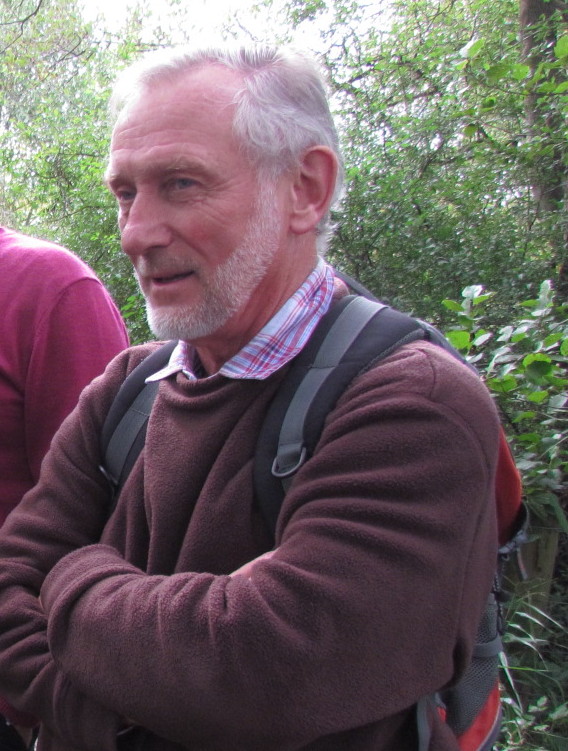
Sir John is Chairman of the Yorkshire Wildlife Trust and he will speak briefly about the role of the YWT in these bids, before giving an update on the present state of the YWT and some of the other exciting challenges and opportunities that lie ahead.
Professor Sir John Lawton was Chairman of the Royal Commission on Environmental Pollution from 2005 until 2011, and formerly Chief Executive of the Natural Environment Research Council (1999-2005). He is a Past President of the British Ecological Society and is currently a Vice-president of RSPB.
His scientific interests have focussed on the population dynamics and biodiversity of birds and insects, with emphasis over the last two decades on the impacts of global environmental change.
Kate Lock, Chair of the York Environment Forum, said: ‘We are delighted to welcome Professor Sir John Lawton to speak to us on this important issue. The York Environment Forum is lobbying hard for the natural environment to be valued in its own right, and for the many significant social and economic benefits it has that can make urban living healthier, safer, more prosperous and infinitely more pleasant.’
The York Environment Forum meeting is at Room 2 of the The Guildhall in York on Monday 8 October at 4.30pm. New members and observers are welcome. Numbers are limited: email Klockworks@btinternet.com or telephone 07792 633984 if you wish to attend.

 York Environment Forum